
Menu close
X
Menu close
X
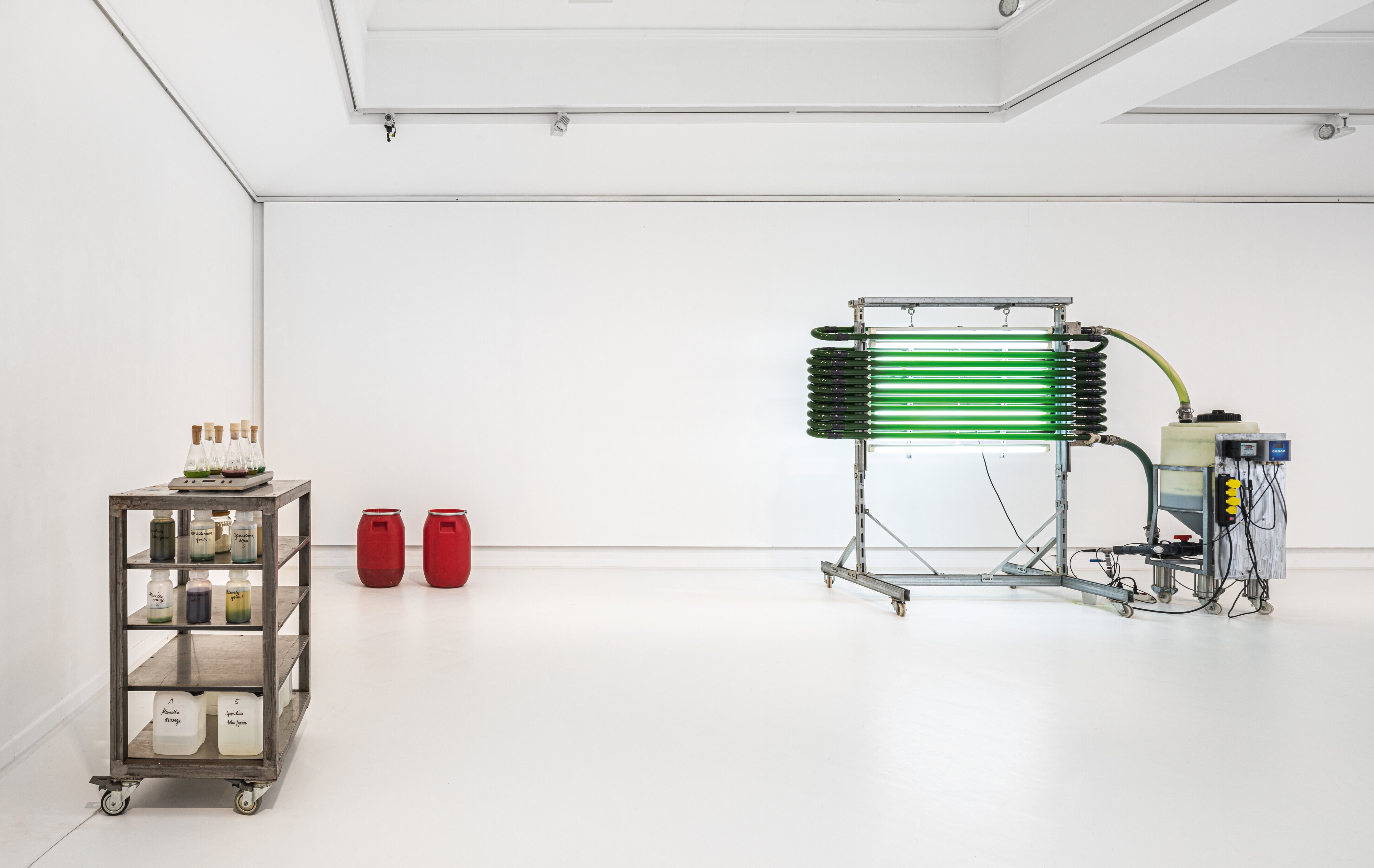
Laboratory as an art installation in the museum

Fig. 2
Algenlabor
Two objects of the installation were reconstructed as original algae systems of the kind used in laboratories. Various species of algae were cultivated in the system with ten algae containers. In the second system, Chlorella algae grew in the glass tubes. They are used to produce plant-based substances, for the food industry among others, and are regarded as a possible solution for feeding humanity in the future.
Next to the algae machines, the 70 m² room contained a laboratory shaker with six types of algae on a mobile steel frame with storage bottles filled with various types of algae for cultivation, as well as a plinth (1 × 1 × 0.7 m) with natural Spirulina blue under a glass pane. Artificial light or sunlight and circulating water are sufficient for the algae to grow. Year of creation: 2019.
In 2019 the installation was part of the exhibition “Arten und Elemente” at the Kallmann Museum in Ismaning, Germany, and in the adjacent Schlosspark on the theme of environment, climate and consequences.
Photographs: Patrik Graf, Munich, Germany.
Sponsors, Partners
Algenlabor: Jörg Ullmann, algae specialist and head of Roquette Klötze. Realised with funding from the Stiftung Kunstfonds, Germany.
Exhibition: “Arten und Elemente (i)”
Publication: “Arten und Elemente”

Fig. 3
Fig. 1: A – Algenlabor, 2019, laboratory shaker with 6 types of algae, steel base frame with castors, 96 × 50 × 65 cm; red plastic barrels for algae solution; B – laboratory algae production machine, glass tubes, plastic hoses, Spirulina algae solution, mobile plastic container (125 × 45 × 45 cm), pump, sensors, electronic control, UV light, steel frame with castors, 204 × 200 × 100 cm
Fig. 2: laboratory algae production system, various types of algae (Phalodactylum brown, Spirulina blue / green, Amorella green, Chlorella green, Porphyridium red, Cyanidium blue, Muriella orange/Chromochloris zofingiensis, Scenedesmus green), oxygen supply with control, UV light, steel frame, compressor, transparent plastic hoses, 180 × 100 × 80 cm
Fig. 3: laboratory algae production machine
Fig. 4: plinth with natural Spirulina blue, 100 × 100 × 70 cm

Fig. 4

Fig. 4
Fig. 4
©
2026
Markus Heinsdorff Copyright.
©
2026
Markus Heinsdorff Copyright.
©
2026
Markus Heinsdorff Copyright.
©
2026
Markus Heinsdorff Copyright.