
Menu close
X
Menu close
X


Kreis & Fläche
Tiefgründig blau II
Compartment boxes made of polished, reflective aluminium with an ultramarine-blue coated back panel. The incidence of light and its reflection create an intense blue glow in the cavities. The blue is reflected on all surfaces, similar to a kaleidoscope.
Blue stands for the elements of water and air and for the phenomenon of reflection.
Dimensions: height 57 cm, width 15 cm, depth 15 cm, material thickness 0.8 cm. Year of creation 2003.
Fig. left: 1 of 6 compartment boxes.
Tiefgründig blau I
9 compartment boxes made of white-lacquered wooden panels. Back panel ultramarine blue. Reflection of the colour on all side surfaces.
Dimensions: height 57 cm, width 15 cm, depth 15 cm, material thickness 0.8 cm. Year of creation 2002. (figure above)
Exhibition: “Skyplace”, Galerie Gaya, Bali, Indonesia, 2002.


Red Window
The four circular discs are spaced 18 cm apart and are held together only by three wooden inserts (wedges) as a plug-in joint.
Circle diameter 218 cm, width 70 cm, plywood panels, thickness 4 cm, red acrylic paint. Year of creation 2002.
In many Asian cultures, the circular form is of central importance – in architecture, for gates and passageways, for openings and windows, or in art. Often only plug or dowel joints are used for everyday objects or buildings – from the wooden temple to the simple bamboo structure.
These mostly highly precise, traditional techniques are often found today only in museums or historic buildings, which survive earthquakes thanks to their flexible joints and endure for centuries or even millennia.
Exhibition: “Skyplace”, Galerie Gaya, Bali, Indonesia, 2002, on the occasion of the “airship installation” of the same name and Markus Heinsdorff’s first bamboo project.
Fig.: the circular discs are held together by three wooden inserts.
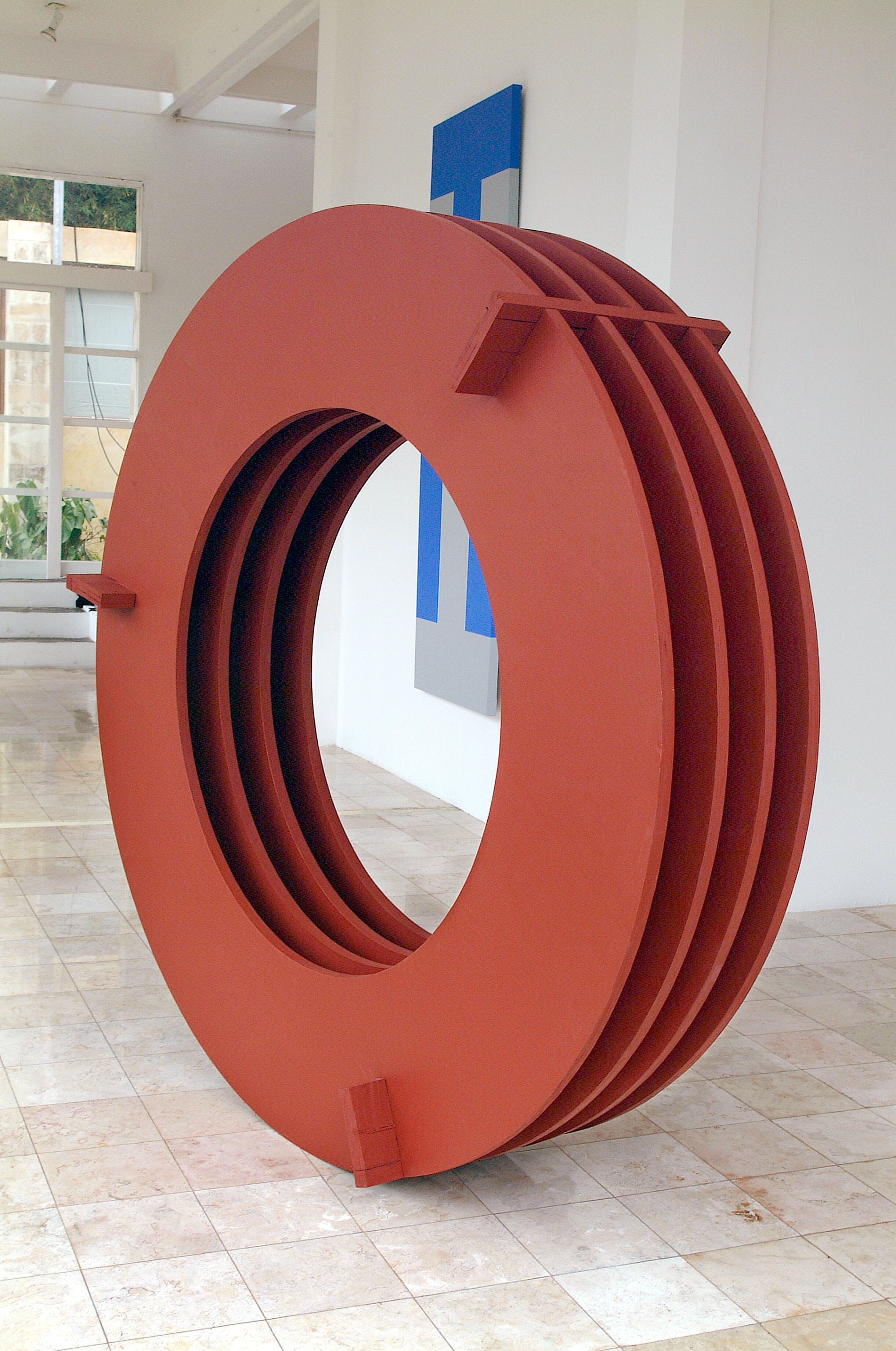
Red Window
The four circular discs are spaced 18 cm apart and are held together only by three wooden inserts (wedges) as a plug-in joint.
Circle diameter 218 cm, width 70 cm, plywood panels, thickness 4 cm, red acrylic paint. Year of creation 2002.
In many Asian cultures, the circular form is of central importance – in architecture, for gates and passageways, for openings and windows, or in art. Often only plug or dowel joints are used for everyday objects or buildings – from the wooden temple to the simple bamboo structure.
These mostly highly precise, traditional techniques are often found today only in museums or historic buildings, which survive earthquakes thanks to their flexible joints and endure for centuries or even millennia.
Exhibition: “Skyplace”, Galerie Gaya, Bali, Indonesia, 2002, on the occasion of the “airship installation” of the same name and Markus Heinsdorff’s first bamboo project.
Fig.: the circular discs are held together by three wooden inserts.
©
2026
Markus Heinsdorff Copyright.
©
2026
Markus Heinsdorff Copyright.
©
2026
Markus Heinsdorff Copyright.
©
2026
Markus Heinsdorff Copyright.