
Menu close
X
Menu close
X

Mobile City – Bicycle, Art and Climate
Space Lab, Terminal 2, Munich Airport, 2025
The exhibition “Mobile City” by Markus Heinsdorff explores the themes of the bicycle, urban development and the environment through a range of works. It includes a contribution by the architect Benedikt Hartl on Japan and the documentation of a joint project with the street art group CaliGraph in Harare. In addition to objects, installations, drawings and photographs, a text contribution by the
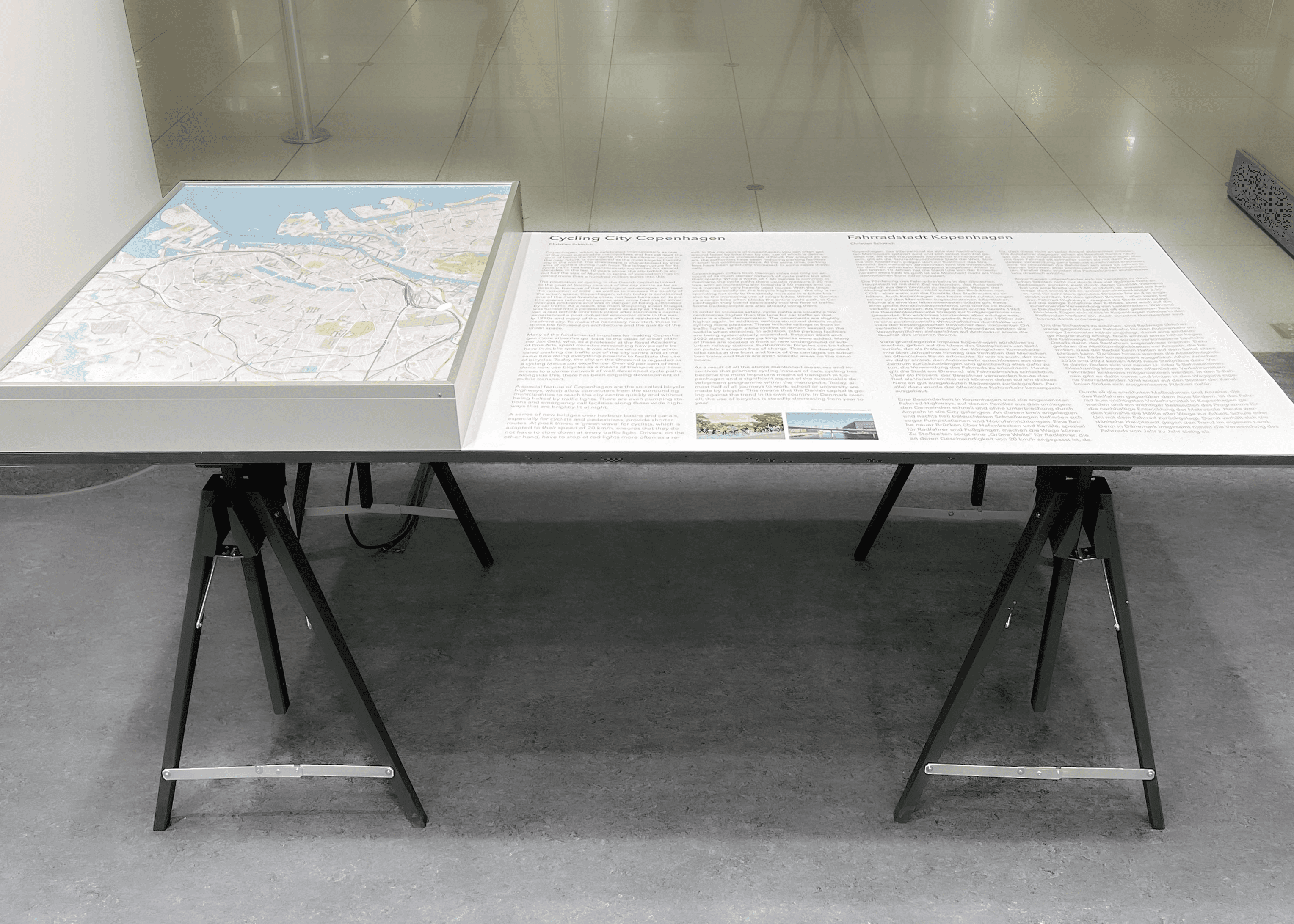
architect and journalist Christian Schittich offers an insight into the situation in Copenhagen, Europe’s leading cycling city.
Many cities around the world are choking on car traffic. Cycling there is often life-threatening. Artistic activities are intended to draw attention to the problem and to initiate a contribution to reducing pollutants and their climate impact. Besides the environmental burden caused by the displacement of the bicycle, in developing and emerging countries the social consequences for the poorer population additionally play a role – linked to the
questions: How can cities be designed for the future? What will the mobility of the future look like? The bicycle and public transport will certainly play an important part in this. Cities such as Copenhagen and Amsterdam in Europe are already showing how mobility and society can develop together through climate-neutral planning of urban spaces.
Fig. above: view from the check-in hall of Terminal 2 (Level 04) into the exhibition.
Fig. left: travellers in the exhibition.


During stays in various countries and cultures, Markus Heinsdorff portrayed bicycles and their owners. 36 portraits from the series were shown in the exhibition together with the “Dreirad” as a carousel and a self-illuminating bicycle object set into the wall, entitled “E-Bike”.
In addition, there are images by the architect Benedikt Hartl, who travels the world by bicycle, recording buildings and landscapes in sketches and his journeys in videos.

7
A documentation also presents the festival “Bicycle instead of Car”, developed by Markus Heinsdorff together with the African artists’ collective CaliGraph, and his installation “Bicycle Wall”, realised in Harare, Zimbabwe, in 2024 with the support of the cities of Munich and Harare. In many poorer countries such as Zimbabwe, the bicycle can enable mobility and form the basis for small businesses. It can thus contribute substantially to livelihoods and therefore also to education. In this respect, the bicycle

1
stands for sustainable mobility, as does public transport, as an important part of a transnational climate alliance.
Exhibition – Partners/Sponsors
Terminal 2 Gesellschaft; Academy of Art + Architecture for Climate, Environment, Society, Raitenhaslach, in collaboration with the House of Photography and the City of Burghausen.
Further partners/sponsors “Harare – Zimbabwe”, see “Bicycle instead of Car”.

1.7
During stays in various countries and cultures, Markus Heinsdorff portrayed bicycles and their owners. 36 portraits from the series were shown in the exhibition together with the “Dreirad” as a carousel and a self-illuminating bicycle object set into the wall, entitled “E-Bike”.
In addition, there are images by the architect Benedikt Hartl, who travels the world by bicycle, recording buildings and landscapes in sketches and his journeys in videos.
7
A documentation also presents the festival “Bicycle instead of Car”, developed by Markus Heinsdorff together with the African artists’ collective CaliGraph, and his installation “Bicycle Wall”, realised in Harare, Zimbabwe, in 2024 with the support of the cities of Munich and Harare. In many poorer countries such as Zimbabwe, the bicycle can enable mobility and form the basis for small businesses. It can thus contribute substantially to livelihoods and therefore also to education. In this respect, the bicycle
1
stands for sustainable mobility, as does public transport, as an important part of a transnational climate alliance.
Exhibition – Partners/Sponsors
Terminal 2 Gesellschaft; Academy of Art + Architecture for Climate, Environment, Society, Raitenhaslach, in collaboration with the House of Photography and the City of Burghausen.
Further partners/sponsors “Harare – Zimbabwe”, see “Bicycle instead of Car”.
1.7

5

8

7
4

2
Object: “E-Bike”
Object: “Dreirad”
Object: “Bicycle Wall I”
Text: “Bicycle instead of Car” (German, English)
Contribution: “Architecture on Wheels: Japanese Spaces in Flow”, Benedikt Hartl
Contribution: “Fahrradstadt Kopenhagen”, Christian Schittich
1 – table with exhibition text and a portrait from the series “Mobile City” as a light box
2 – two text and image banners on the exhibition and on the project “Harare”
3 – “Architecture on Wheels: Japanese Spaces in Flow”, 24 drawings by Benedikt Hartl
4 – table object with a city map light box and the text contribution “Fahrradstadt Kopenhagen” by Christian Schittich
5 – “Bicycle Wall II” – wall with 21 rotating bicycle wheels
6 – “E-Bike” – self-illuminating bicycle set into the wall
7 – “Mobile City” – 36 bicycle portraits
8 – “Dreirad” – object made of three bicycles
5
8
7
4
2
Object: “E-Bike”
Object: “Dreirad”
Object: “Bicycle Wall I”
Text: “Bicycle instead of Car” (German, English)
Contribution: “Architecture on Wheels: Japanese Spaces in Flow”, Benedikt Hartl
Contribution: “Fahrradstadt Kopenhagen”, Christian Schittich
1 – table with exhibition text and a portrait from the series “Mobile City” as a light box
2 – two text and image banners on the exhibition and on the project “Harare”
3 – “Architecture on Wheels: Japanese Spaces in Flow”, 24 drawings by Benedikt Hartl
4 – table object with a city map light box and the text contribution “Fahrradstadt Kopenhagen” by Christian Schittich
5 – “Bicycle Wall II” – wall with 21 rotating bicycle wheels
6 – “E-Bike” – self-illuminating bicycle set into the wall
7 – “Mobile City” – 36 bicycle portraits
8 – “Dreirad” – object made of three bicycles

Fig. left: documentation of the joint project and festival “Bicycle instead of Car” with the installation Bicycle Wall and the photo exhibition
“Mobile City” by Markus Heinsdorff in Harare, Zimbabwe, 2024, as a text and image banner in the exhibition.
Fig. left: documentation of the joint project and festival “Bicycle instead of Car” with the installation Bicycle Wall and the photo exhibition
“Mobile City” by Markus Heinsdorff in Harare, Zimbabwe, 2024, as a text and image banner in the exhibition.
Fig. left: documentation of the joint project and festival “Bicycle instead of Car” with the installation Bicycle Wall and the photo exhibition
“Mobile City” by Markus Heinsdorff in Harare, Zimbabwe, 2024, as a text and image banner in the exhibition.
Fig. left: documentation of the joint project and festival “Bicycle instead of Car” with the installation Bicycle Wall and the photo exhibition
“Mobile City” by Markus Heinsdorff in Harare, Zimbabwe, 2024, as a text and image banner in the exhibition.
©
2026
Markus Heinsdorff Copyright.
©
2026
Markus Heinsdorff Copyright.
©
2026
Markus Heinsdorff Copyright.
©
2026
Markus Heinsdorff Copyright.