
Menu close
X

1 – Eremitage Bayreuth
Königshäuser – Residenzen
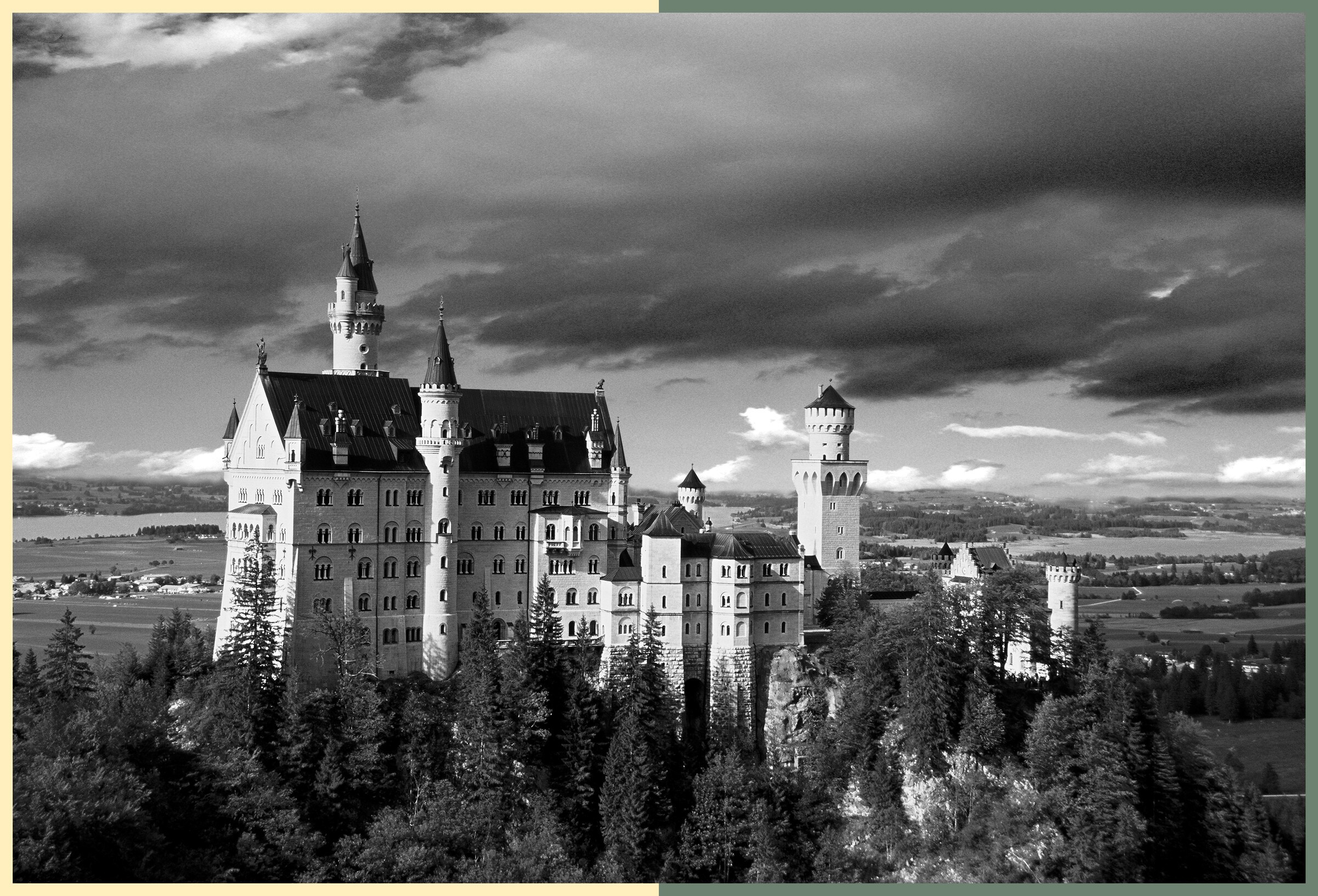
Black-and-white portraits of 19 Bavarian palaces/residences and castles from various centuries. Each image consists of two visual and two sound elements. The photographs were extended with sky recorded elsewhere. The two predominant colours of the buildings and their surroundings form the frames of the images. The sounds, which come directly from the image surface, blend the noises of the respective surroundings, recorded on site and supplemented with music from the period in which the
residences were built. The sound is played through resonance coils mounted in the centre of the back of each image. These make the image panels vibrate in such a way that they function like loudspeakers. Despite visible cable connections, coils and playback devices, visitors puzzle over the mysterious source of the sound – the images themselves became the sound source. Each image was mounted on a frame (square steel tube 1.2 × 1.2 cm) 200 cm high × 120 cm wide. The series of portraits, photographed and edited by Markus Heinsdorff, ranges in time from the medi-
eval Burg Prunn in the Altmühl Valley (11th century) to King Ludwig II’s famous fairy-tale castle Neuschwanstein (1868), which can be read as a romantic replica of a medieval castle.
Exhibitions
Gallery, South China University of Technology, Guangzhou, China, 2008
Changfa Towers, Daxinggong Square, Nanjing, China, 2007
Gallery/foyer, Sun Yat-sen Library of Guangdong Province, Culture Festival, Guangzhou, China, 2006

Fig. left: Exhibition on the ground floor of the Changfa Towers in Nanjing – visitors try to locate the source of the sound in the images.
Fig. left: Exhibition on the ground floor of the Changfa Towers in Nanjing – visitors try to locate the source of the sound in the images.
Fig. left: Exhibition on the ground floor of the Changfa Towers in Nanjing – visitors try to locate the source of the sound in the images.
Fig. left: Exhibition on the ground floor of the Changfa Towers in Nanjing – visitors try to locate the source of the sound in the images.
Collaboration
The exhibitions took place in collaboration with the Goethe-Institut Beijing as part of the presentation of Germany in China (2007–2010). The selection of buildings and of music from the period of their construction was advised by the art historian Gottfried Knapp, Munich.
Photographs
From left to right: 1 – Eremitage Bayreuth, 2 – Schloss Herrenchiemsee, 3 – Burg Burghausen, 4 – Willibaldsburg Eichstätt, 5 – Schloss Ansbach, 6 – Burg Lauenstein, 7 – Veste Coburg, 8 – Schloss Mespelbrunn (Spessart “haunted castle”), 9 – Schloss Aschaffenburg, 10 – Residenz Würzburg,
11 – Burg Harburg, 12 – Kaiserburg Nürnberg, 13 – Plassenburg, Kulmbach, 14 – Burg Prunn, 15 – Felsengarten Sanspareil near Bayreuth, 16 – Schloss Neuschwanstein, 17 – Amalienburg München, Hall of Mirrors, 18 – Residenz München, Königsbau/Antiquarium, 19 – Residenz München, 20 – Neues Schloss Schleißheim.

2


3


4


2
3
4
2
3
4




©
2026
Markus Heinsdorff Copyright.
©
2026
Markus Heinsdorff Copyright.
©
2026
Markus Heinsdorff Copyright.
©
2026
Markus Heinsdorff Copyright.