
Menu close
X
Black Box – über das Sehen
The Black Box is a wooden box with lenses in which, through the refraction of light, the surroundings are projected upside down onto a ground-glass screen – comparable to the way the human eye works.
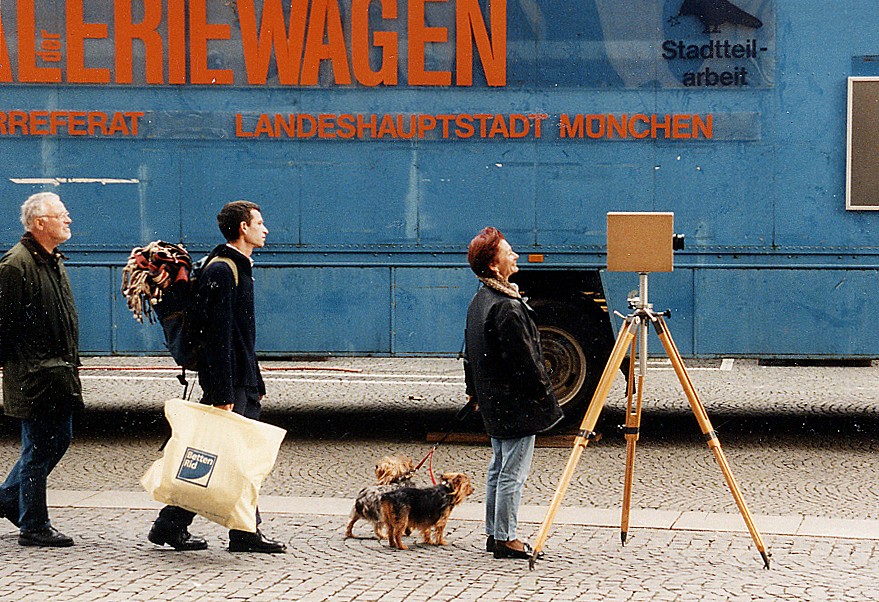
The box was set up temporarily in central, busy squares in various cities and countries. Groups of interested passers-by formed immediately, looking at the projection on the back, trying to understand how it worked and the physics behind it, or photographing each other and their surroundings through the box.
Although detailed knowledge of the anatomy of the human eye exists, many questions about how our consciousness works remain open. It is still unclear how our perception of the world arises from it.
On Tian’anmen Square, gatherings of groups have been strictly regulated since the violent suppression of the protest movement on 3/4 June 1989. After ten minutes, the police brought the camera installation to an end.
Material: daylight projection box made of MDF; 36 × 36 × 36 cm; front: 50 mm medium-format camera lens; back: 35 × 35 cm, Fresnel lens; height-adjustable wooden photo tripod.
Locations
Tian’anmen Square and city gate, Beijing, China, 2001
Piazza del Plebiscito, Naples, Italy, 1999
Times Square, New York, USA, 1998
Marienplatz and Odeonsplatz, Munich, Germany, 1998


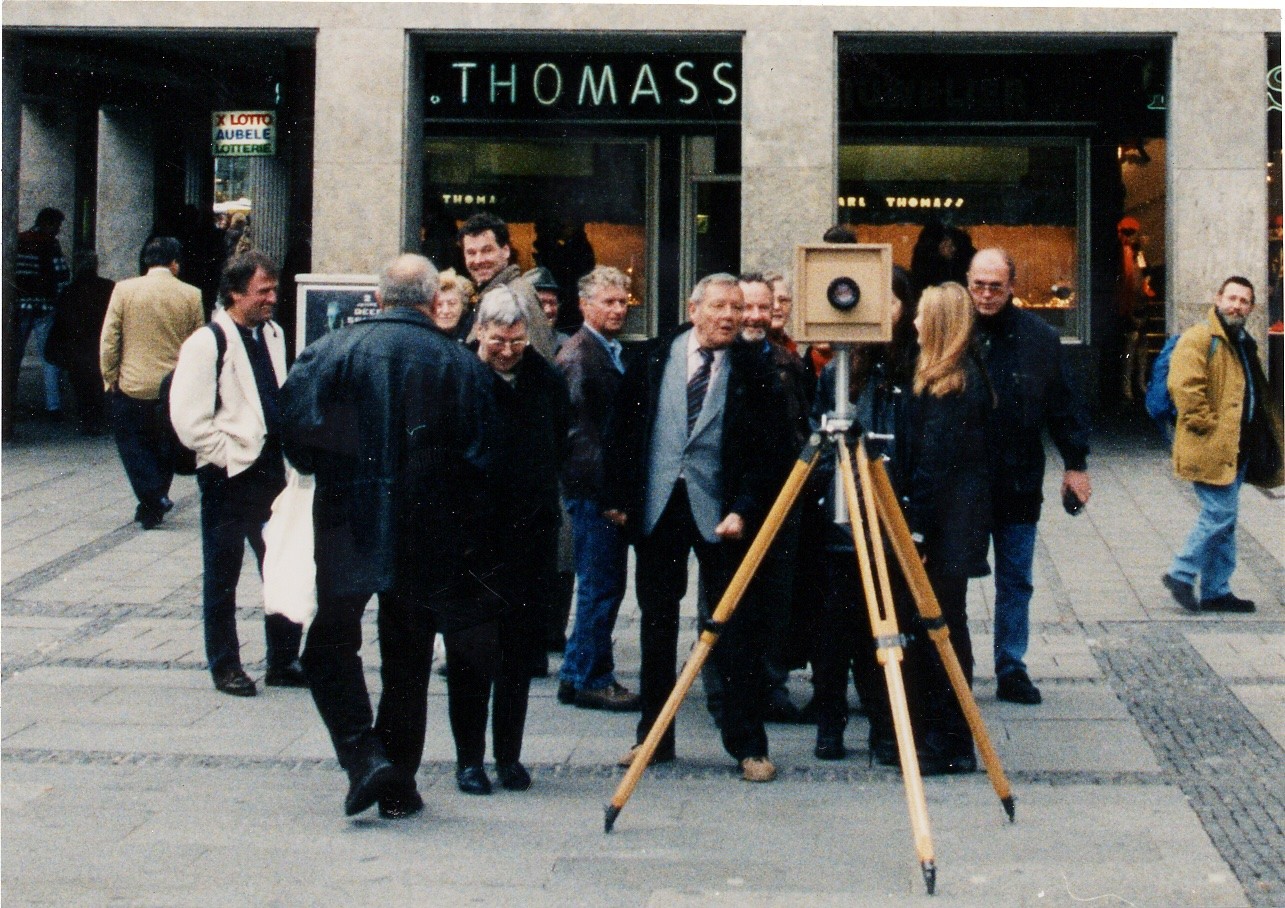

Fig. top left 1: Times Square, New York. Passers-by photograph the projection.
Fig. top left 2: Passers-by on Tian’anmen Square, Beijing, China.
Fig. top right 1–3: Piazza del Plebiscito and its approaches. Passers-by form a group around the box and photograph each other “upside down”. Police officers on patrol inspect the box from all sides.
Fig. bottom right 4–6: Passers-by on Odeonsplatz in Munich, with views towards the Feldherrnhalle and Marienplatz, the large square in the city centre in front of the town hall.

©
2026
Markus Heinsdorff Copyright.
©
2026
Markus Heinsdorff Copyright.
©
2026
Markus Heinsdorff Copyright.
©
2026
Markus Heinsdorff Copyright.