
Menu close
X

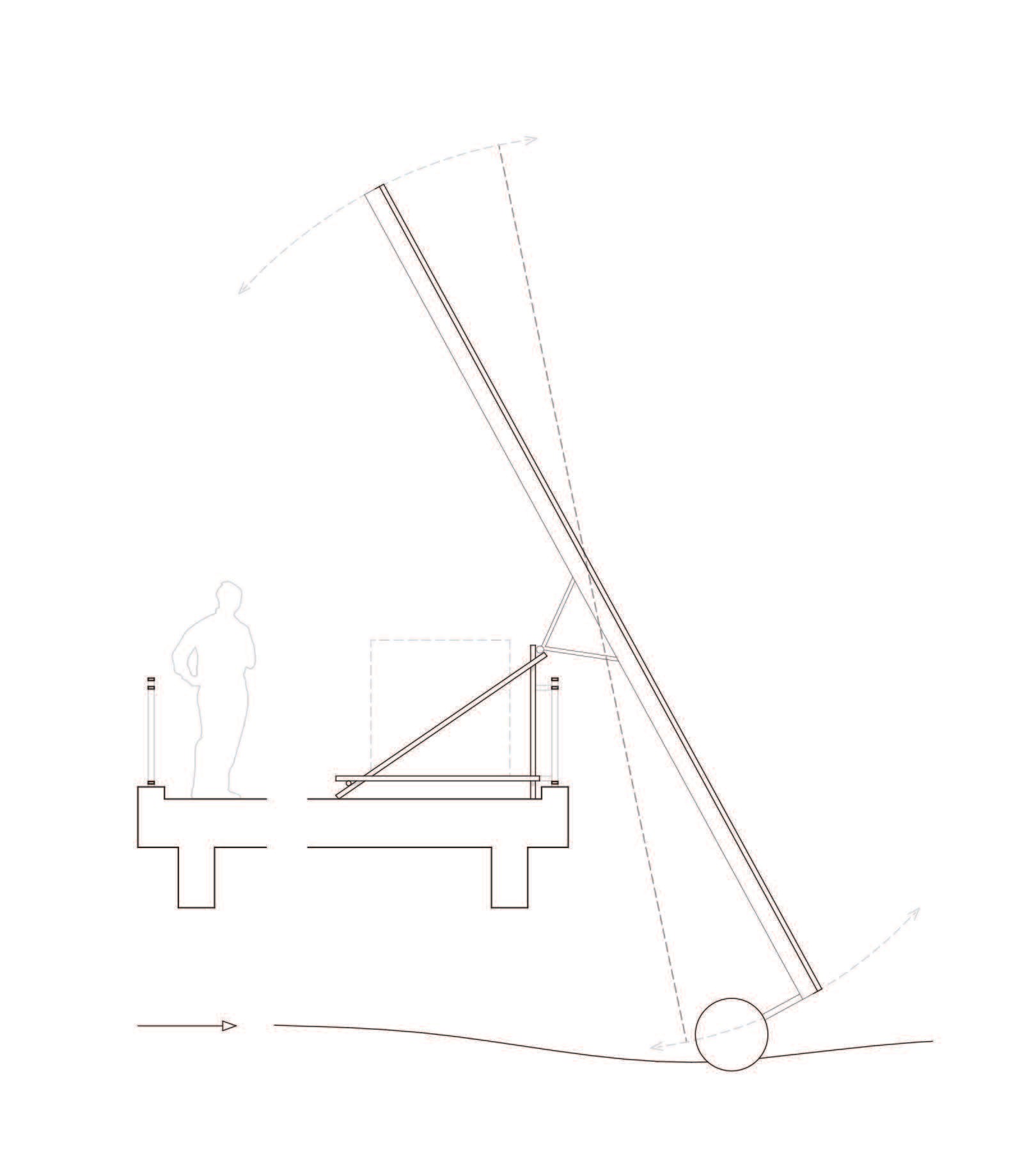
Fig. top: side view, section: mirror construction with float and mounting/fixing on the bridge.

Isarinstallation
Isar canal, Munich, Germany, 1990
Mirror object on the canal in the centre of Munich – seven objects were braced along 200 m of the river. One of the works was a mirror 9.5 m high and 4 m wide made of aluminium panels on a steel frame construction. Two 200-litre steel drums were mounted as floats at the foot of the frame.
Through the current, the movement of the water combined with the reflection of the sky into a play of light and reflection on the 38 m² reflector surface, angled diagonally towards the sky. The construction was mounted movably on the Mariannensteg (footbridge) with scaffolding tubes. Waves from flooding and changing water levels were compensated for by the floats. A 1.9-tonne boulder served as a counterweight and to secure the object on the bridge.
To view the installation, a 5 m high platform with stairs for visitors was built in the middle of the next bridge (Praterwehr), 200 m away. At night the installation was lit from the banks.
Fig. left: mounting/fixing of the mirror with a 1.9-tonne rock as a counterweight.
Fig. top: side view, section: mirror construction with float and mounting/fixing on the bridge.
Isarinstallation
Isar canal, Munich, Germany, 1990
Mirror object on the canal in the centre of Munich – seven objects were braced along 200 m of the river. One of the works was a mirror 9.5 m high and 4 m wide made of aluminium panels on a steel frame construction. Two 200-litre steel drums were mounted as floats at the foot of the frame.
Through the current, the movement of the water combined with the reflection of the sky into a play of light and reflection on the 38 m² reflector surface, angled diagonally towards the sky. The construction was mounted movably on the Mariannensteg (footbridge) with scaffolding tubes. Waves from flooding and changing water levels were compensated for by the floats. A 1.9-tonne boulder served as a counterweight and to secure the object on the bridge.
To view the installation, a 5 m high platform with stairs for visitors was built in the middle of the next bridge (Praterwehr), 200 m away. At night the installation was lit from the banks.
Fig. left: mounting/fixing of the mirror with a 1.9-tonne rock as a counterweight.
©
2026
Markus Heinsdorff Copyright.
©
2026
Markus Heinsdorff Copyright.
©
2026
Markus Heinsdorff Copyright.
©
2026
Markus Heinsdorff Copyright.